LAHORE: The Punjab government has notified rules for the Punjab Regulation of Kite Flying Ordinance, 2025, but has yet to decide the scale of kite flying in Lahore as well as other districts across the province.
It has also yet to formally notify the announced dates of a three-day Basant festival from February 6, 2026, in Lahore and elsewhere.
With the notification of rules for the Punjab Regulation of Kite Flying Ordinance 2025, the Punjab Assembly is expected to take up “The Punjab Regulation of Kite Flying Bill, 2025” for approval in its sitting on Monday.
“The Punjab government is currently holding meetings to decide the scale of the three-day Basant festival, ranging from allowing kite flying activities across Lahore, or in some specified grounds or specified rooftops, including known rooftops inside the Walled City,” a source in the Punjab home department told Dawn on Sunday.
Sources also say the Punjab government has yet to formally notify the announced basant dates in Lahore.
The Punjab government instructed all deputy commissioners in the province to register kite and string manufacturers, traders or sellers and inform the government when they would be ready to hold the Basant festival in their respective districts.
“While the Basant festival was actively celebrated in Lahore, Rawalpindi, Faisalabad and other districts, the respective DCs (deputy commissioners) will formally inform the Punjab government whether they will hold the Basant festival on the Punjab government’s announced dates or another,” the sources privy to developments told Dawn.
Under the leadership of the then-chief minister, Shehbaz Sharif, Punjab had banned the Basant festival in 2007 following an increasing number of deaths and serious injuries caused to motorcyclists by prohibited and sharp kite strings.
The Punjab government is now making efforts to revive the festival, on the recommendation of PML-N chief and former premier Nawaz Sharif, following meetings with stakeholders.
Kite flying is currently banned across the province and will be allowed only on specific days and designated locations across the province after the passage of the Punjab Regulation of Kite Flying Bill, 2025.
Under the bill, flying kites with metallic wires, nylon cord or strings coated with glass or other sharp materials is prohibited, along with the manufacturing, transport, storage and sale of kites and hazardous strings.
Violators involved in kite-flying could face three to five years’ imprisonment or a fine of up to Rs2 million, while those manufacturing or selling banned materials may be punished with five to seven years in jail and fines up to Rs5m.
The bill empowers deputy commissioners to allow “permissible kite-flying” on specific days and at designated locations, subject to government approval and strict conditions. However, the use of sharp or metallic strings will remain banned under all circumstances.
New rules
Under the Punjab Regulation of Kite Flying Rules, 2025, manufacturers, traders or sellers of authorised kite flying material must apply to the DC and provide specified documents.
Kite flying associations can also register themselves with the DCs concerned through an online application by the association president or general secretary.
The DCs must verify the contents of applications and documents within 10 days of receiving them. Upon verification, the DC shall decide the application and issue a certificate of registration having a one-year validity. According to the rules, manufacturing, trading, transporting, selling or using a string coated with sharp materials is prohibited.
The notified rules also proposed an annual non-refundable registration fee structure, explaining that the government will charge Rs1,000 each to register manufacturers, traders and sellers, while they will charge Rs5,000 to register a kite flying association.
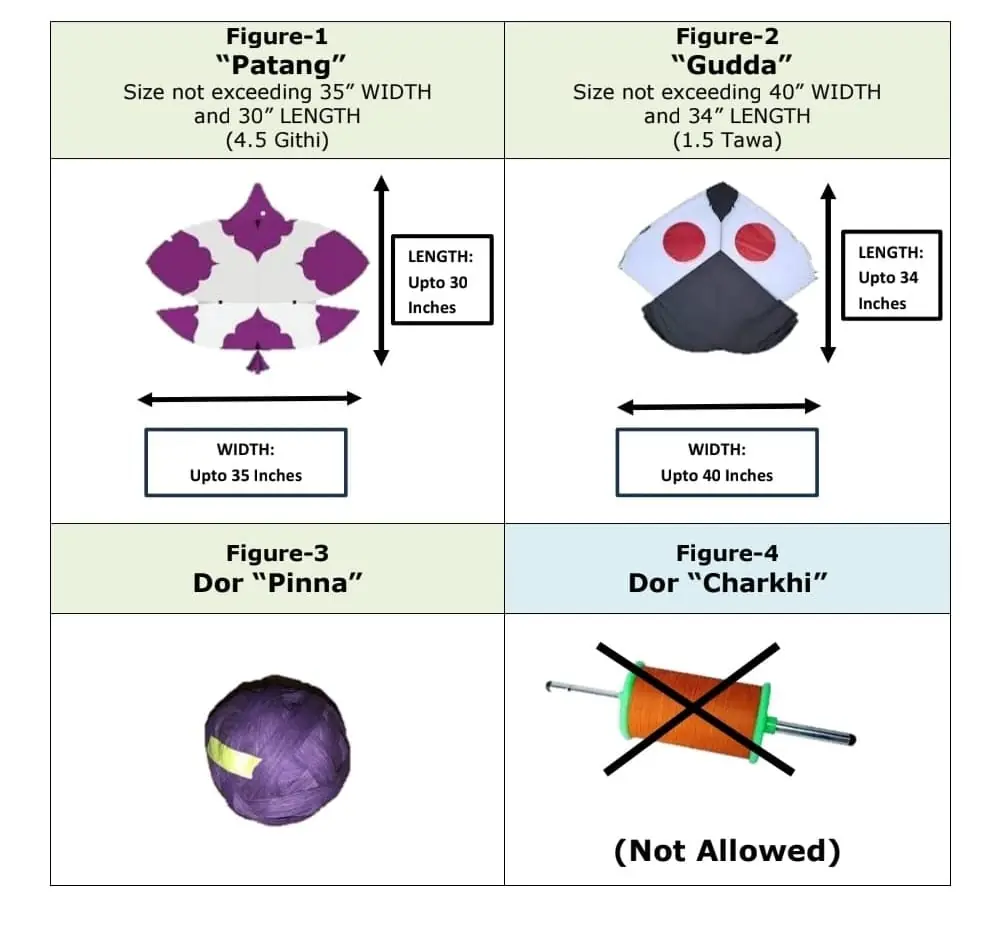
Specifications for permitted kites were also shared. A ‘patang’ shall not exceed 35 inches in width and 30 inches in length, while a ‘gudda’ cannot exceed 40 inches in width and 34 inches in length.
‘Dor’ (string) must be made of cotton with not more than nine threads and no less than 28 counts. The string must be wound in the shape of a ball, since spools are prohibited.
Last July, a 13-year-old boy was electrocuted while catching a stray kite in Kasur’s Basti Lal Shah area.
The boy rushed to catch a stray kite attached to a metal string. The metal string fell on the transmission line before he caught it.
In March last year, a motorcyclist died after a metal string, believed to be part of a stray kite, cut his throat in Faisalabad. Following the incident, Punjab Chief Minister Maryam Nawaz ordered a crackdown on those involved in kite-flying.
The provincial government intensified its crackdown on kite-flying by declaring kite-making, flying, and transportation as non-bailable offences in August 2024.
from Dawn - Home https://ift.tt/mHAYy4R
via Blogger https://ift.tt/KvrmZOU
December 22, 2025 at 12:02AM